Sight words Word Search
This sight words word search hides words like about, after, again to find. Play it free online or print the PDF with the answer key, a handy sight words vocabulary activity.
10 words · 11×11 grid · Medium · Answer key included · Free printable PDF
Tap the first and last letter of a word — or use arrow keys and Enter. Dragging works too.
- ABOUT
- AFTER
- AGAIN
- COULD
- EVERY
- FIRST
- FOUND
- GREAT
- HOUSE
- LIGHT
Print this Sight words word search
Did you know?
- about
- About starts with English's most common vowel sound, the uh sound, yet our alphabet has no letter reserved just for it.
- after
- Aftermath originally meant grass that grew after mowing, before the word came to describe what follows an event.
- again
- Two pronunciations are both standard and widely used: it can rhyme with rain or, just as correctly, with hen.
- could
- It never had an L: the letter was added around 1500 only to match would and should, so it stays silent.
- every
- Every number from zero through 999 can be spelled without the letter A in American English; thousand finally introduces it.
- first
- Old English used other for second place, so first's next-door neighbor once had a name that English later replaced with French second.
- found
- A girl searching for stones and sticks found an ancient sword in a Swedish lake, turning shallow-water play into an archaeological discovery.
- great
- Great Britain's great distinguished the island from Brittany in France, using size to tell two similarly named places apart on maps.
- house
- As a noun its s hisses, but as a verb the same s buzzes like a z, no spelling change.
- light
- The silent gh once stood for a throaty sound still heard in German licht; English kept the spelling but dropped the rasp.
- never
- Never-never can mean remote Australian country or buying on installments in Britain, sending one doubled word from a wilderness into a shop.
- other
- Other rhymes with mother but not bother, even though all three finish with the same five letters when written on the page.
- right
- Swedish drivers changed from left to right in 1967, as their country switched road sides in one carefully planned morning.
- their
- Borrowed from Old Norse in the Viking age, this possessive replaced an older English word and now trips up writers everywhere.
- would
- Would began as the past of a verb meaning want or wish, giving today's polite requests an older connection with personal desire.
Trivia
Educator Edward Dolch published a famous 1936 list of words children should know on sight. About how many words were on it?
220 service words (plus 95 nouns).
Words like light, night, and right share a silent letter pair that once spelled a throaty sound. Which two letters?
The letters gh.
The words they, them, and their were borrowed into English from which language family during the Viking age?
Old Norse (Scandinavian).
In could, would, and should, which letter is written but never pronounced?
The letter L.
What name do teachers give to common words learners memorize instantly instead of sounding out letter by letter?
Sight words (or high-frequency words).
In their words
Children are made readers on the laps of their parents.
Emilie Buchwald
The more that you read, the more things you will know. The more that you learn, the more places you'll go.
Dr. Seuss
Is this sight words word search free to print?
This sight words word search is a free printable puzzle with 10 hidden words in an 11×11 grid. Find words like ABOUT, AFTER, AGAIN hidden across, down, and diagonally. You can play it right here in your browser — tap the first and last letter of a word — or download it as a printable PDF with the full answer key on page two. It's free for personal and classroom use, so teachers can print copies for a whole class with no sign-up and no account. Word searches like this one are a proven way to build vocabulary, spelling, and word-shape recognition, which is why they're a favourite with ESL learners, elementary classrooms, and anyone who likes a quiet puzzle with their coffee.
Print this Sight words word search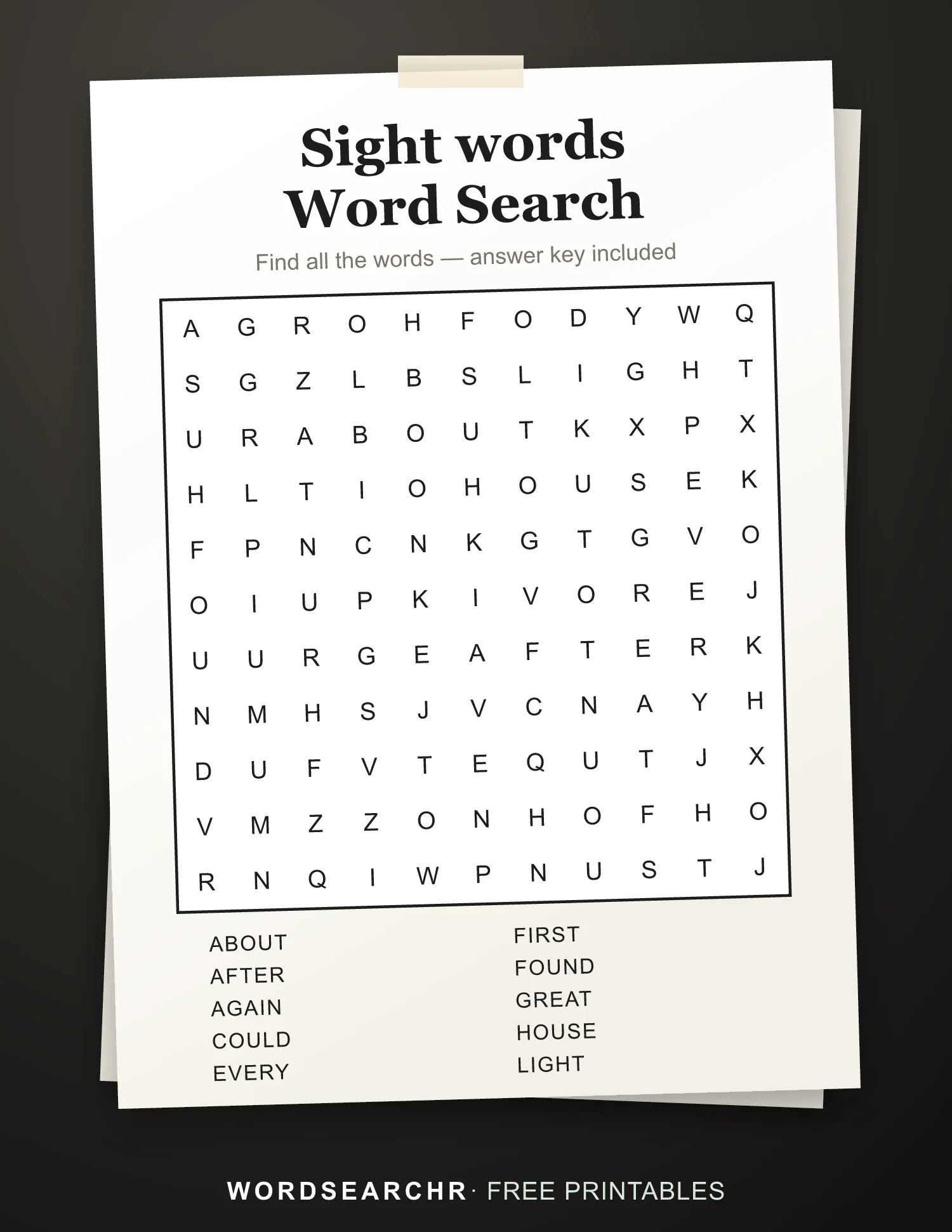
More puzzles

Phrasal verbs Word Search
Look for means search, not gaze at; swap the particle and the meaning flips.
Play →or print
Irregular verbs Word Search
Brought is the past of bring, while bought is the past of buy — easily confused but never interchangeable.
Play →or print
Opposites Word Search
Happy comes from the old word hap, meaning luck, the same root inside happen, perhaps, and mishap.
Play →or print
Prepositions Word Search
Between traces to Old English meaning by the two, so its hidden core is the number two.
Play →or printSources: Dolch word list (Wikipedia) · Mary Walker, the nation's oldest student · Kimani Maruge (Wikipedia) · Why the L is silent in could, would, should (Merriam-Webster)
Word list, facts & trivia researched and compiled by Sam Letterman — spotted a mistake? Tell us and we’ll fix it.