Time Word Search
This time word search hides words like calendar, midnight, morning to find. Play it free online or print the PDF with the answer key, a handy time vocabulary activity.
10 words · 11×11 grid · Medium · Answer key included · Free printable PDF
Tap the first and last letter of a word — or use arrow keys and Enter. Dragging works too.
- CALENDAR
- MIDNIGHT
- TWILIGHT
- SCHEDULE
- TOMORROW
- MORNING
- SUNRISE
- CENTURY
- EVENING
- WEEKEND
Did you know?
- calendar
- When the Gregorian calendar arrived in 1582, ten days vanished: people slept on October 4 and woke on October 15.
- midnight
- On Norway's Arctic islands of Svalbard, the Sun can stay above the horizon from April into August, keeping even midnight in daylight.
- morning
- Roosters crow before dawn because an internal body clock anticipates sunrise, so they call out even in a windowless, darkened room.
- twilight
- At the North Pole, autumn twilight can last weeks after the Sun disappears, stretching an evening-like glow across many ordinary calendar days.
- sunrise
- The sun you glimpse at sunrise is actually still below the horizon; the atmosphere bends its light up over the edge.
- century
- Century eggs get dark colors and jelly-like whites from curing for weeks or months, despite a name that suggests a hundred-year wait.
- evening
- The evening star is not a star at all but the planet Venus, often the first bright point to appear after sunset.
- schedule
- Railway schedules helped replace towns' differing local times with shared clock time, making catching trains part of how British time became standardized.
- tomorrow
- Aymara speakers can gesture behind themselves for the future and ahead for the past, reversing the direction English uses when looking forward.
- weekend
- The two-day weekend spread worldwide only in the twentieth century, as labor movements pushed employers to grant a second rest day.
- season
- Seasons come from Earth's tilt, not its distance from the sun, which is why summer and winter swap between the hemispheres.
- minute
- The minute is a Latin shorthand for the first small part of an hour; the second was simply the second small part.
- yesterday
- Space-station crews can see sixteen sunrises in one Earth day, so watching the Sun alone wouldn't tell them when yesterday became today.
- hourglass
- An hourglass doesn't need sand: finely ground eggshell and powdered marble have also flowed through the narrow neck of old timers.
- fortnight
- Fortnight squeezes fourteen nights into one word, while the older sennight did the same job for seven.
Trivia
Which two months are named after the Roman rulers Julius Caesar and Augustus?
July and August.
How many minutes are there in a full 24-hour day?
1,440 minutes.
What ancient device told the time by casting a moving shadow across marked lines?
A sundial.
September, October, November, and December are named after Latin numbers. Which numbers?
Seven, eight, nine, and ten.
An extra day added to a leap year falls in which month?
February (the 29th).
In their words
It is not that we have a short time to live, but that we waste much of it.
Seneca
Lost time is never found again.
Benjamin Franklin
Is this time word search free to print?
This time word search is a free printable puzzle with 10 hidden words in an 11×11 grid. Find words like CALENDAR, MIDNIGHT, TWILIGHT hidden across, down, and diagonally. You can play it right here in your browser — tap the first and last letter of a word — or download it as a printable PDF with the full answer key on page two. It's free for personal and classroom use, so teachers can print copies for a whole class with no sign-up and no account. Word searches like this one are a proven way to build vocabulary, spelling, and word-shape recognition, which is why they're a favourite with ESL learners, elementary classrooms, and anyone who likes a quiet puzzle with their coffee.
Print this Time word search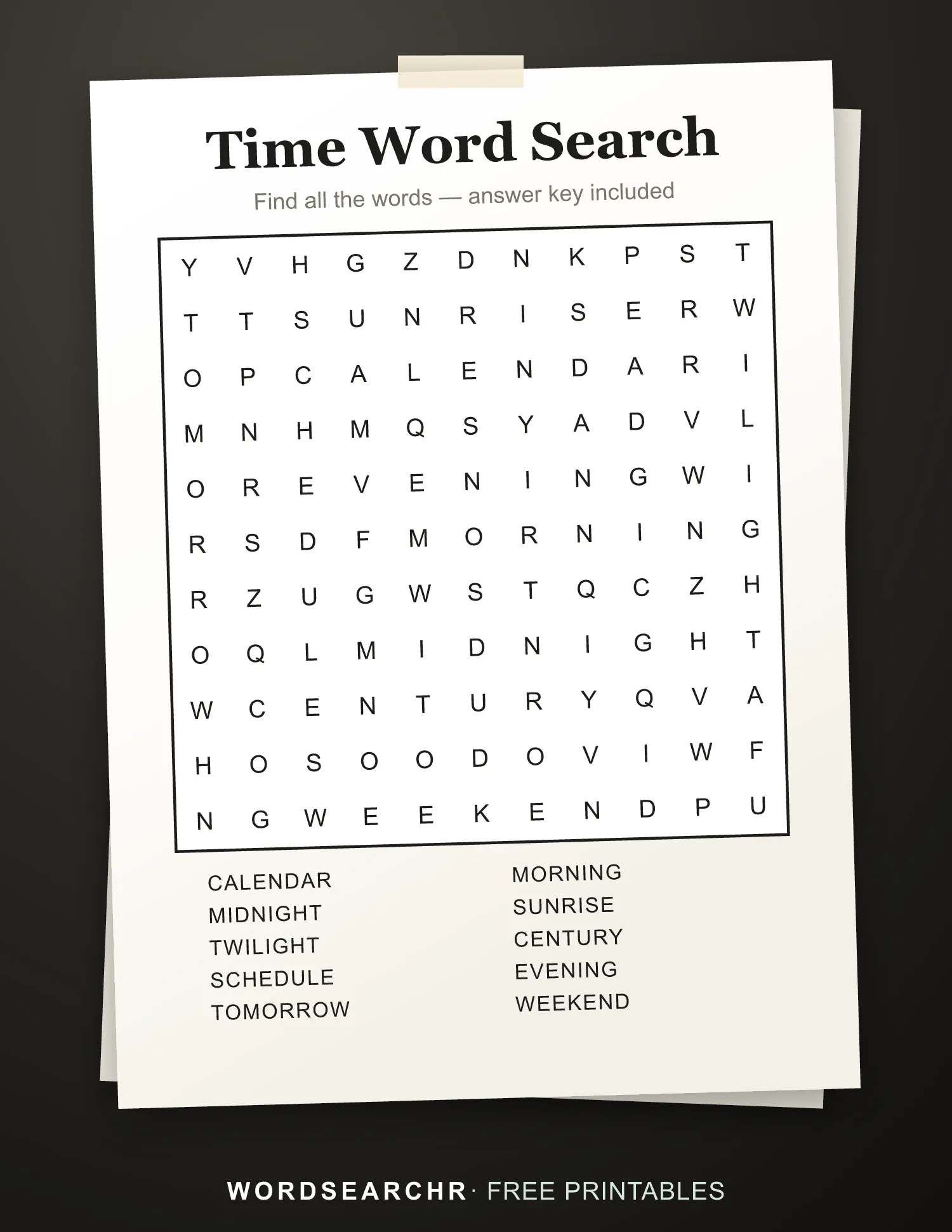
More puzzles

Sight words Word Search
Could never had an L; it was added around 1500 to match would and should.
Play →or print
Phrasal verbs Word Search
Look for means search, not gaze at; swap the particle and the meaning flips.
Play →or print
Irregular verbs Word Search
Brought is the past of bring, while bought is the past of buy — easily confused but never interchangeable.
Play →or print
Opposites Word Search
Happy comes from the old word hap, meaning luck, the same root inside happen, perhaps, and mishap.
Play →or printSources: Beverly Clock (University of Otago) · Gregorian calendar reform of 1582 · Definition of the second (BIPM) · Why the seasons happen (NASA)
Word list, facts & trivia researched and compiled by Sam Letterman — spotted a mistake? Tell us and we’ll fix it.